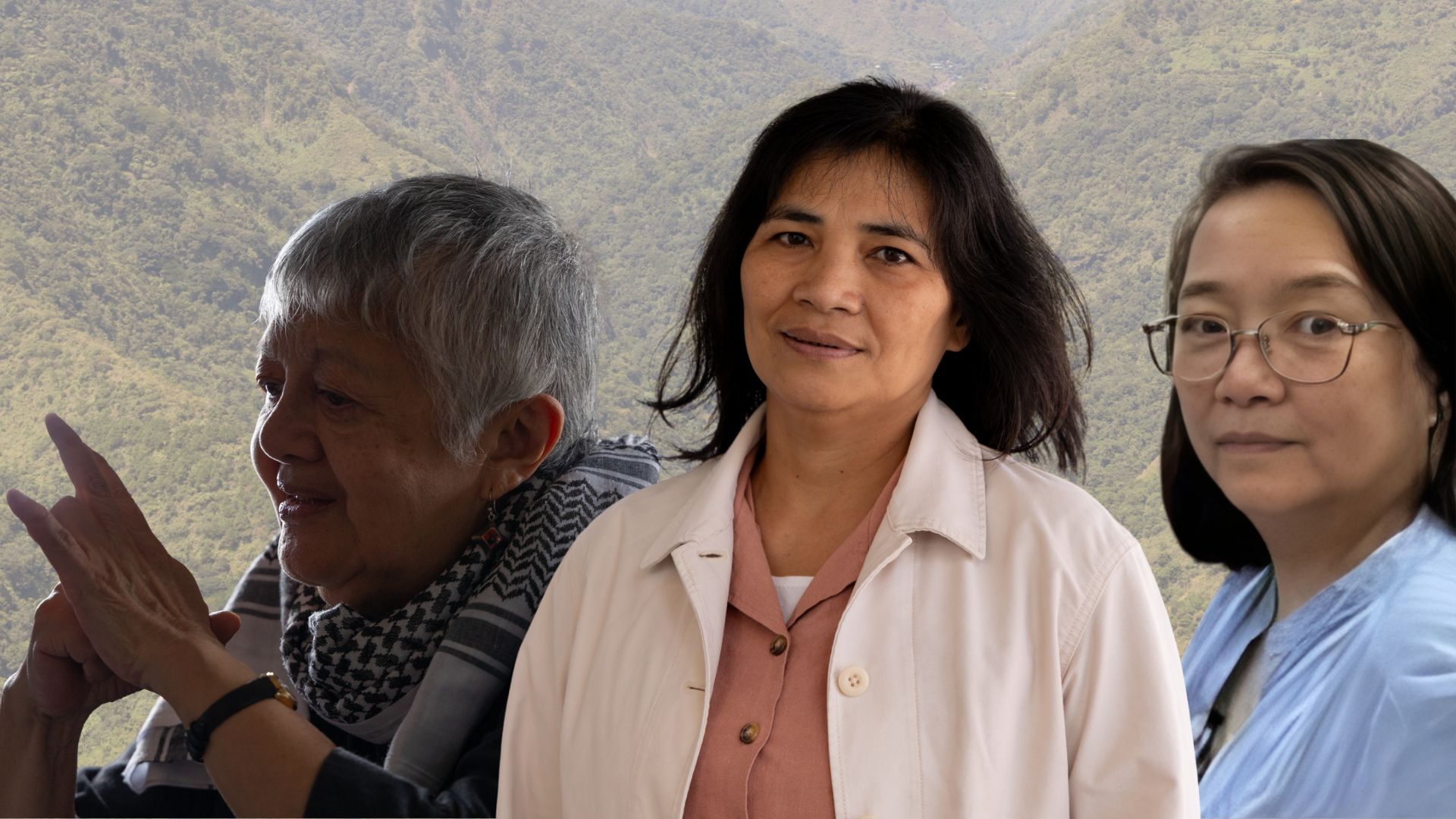
The vast majority of them lost their husbands, fathers and brothers in the war and took on the responsibity of supporting their families.
By: Ruiyao Luo | Methmalie Dissanayake | Keshayinie Edmund
Cooking, feeding the chickens, tending the vegetable patch — Rathneswary’s day begins at six in the morning. After lunch, she hoists the fishing net onto her back and heads to the lagoon.
The weight of the net presses down on her, causing her to hunch slightly. Once in the water, the 10-metre net weighs over 30 kilograms; usually, it would take two people to haul it in, but with no one to help, she ties one end to her waist and drags it to the shore alone. Over the years, she has developed a chronic back condition and has grown accustomed to walking with a stoop.
After three or four hours of hard work, Rathneshwary had caught only a few kilograms of small fish. She hauled in the net and headed home as dusk fell; she did not want her mother to wait too long. This catch was the mother and daughter’s food for the next two days.
Fish curry and vegetables with rice were their daily lunch; if there was any left over, they would have it again for dinner. Eggs and lentils have vanished from the table; she saves the eggs laid by her hens to sell, earning a few hundred rupees a week for the essentials. This is the daily struggle of many Sri Lankans as they scrape by under the long-lasting shadow of the economic crisis.
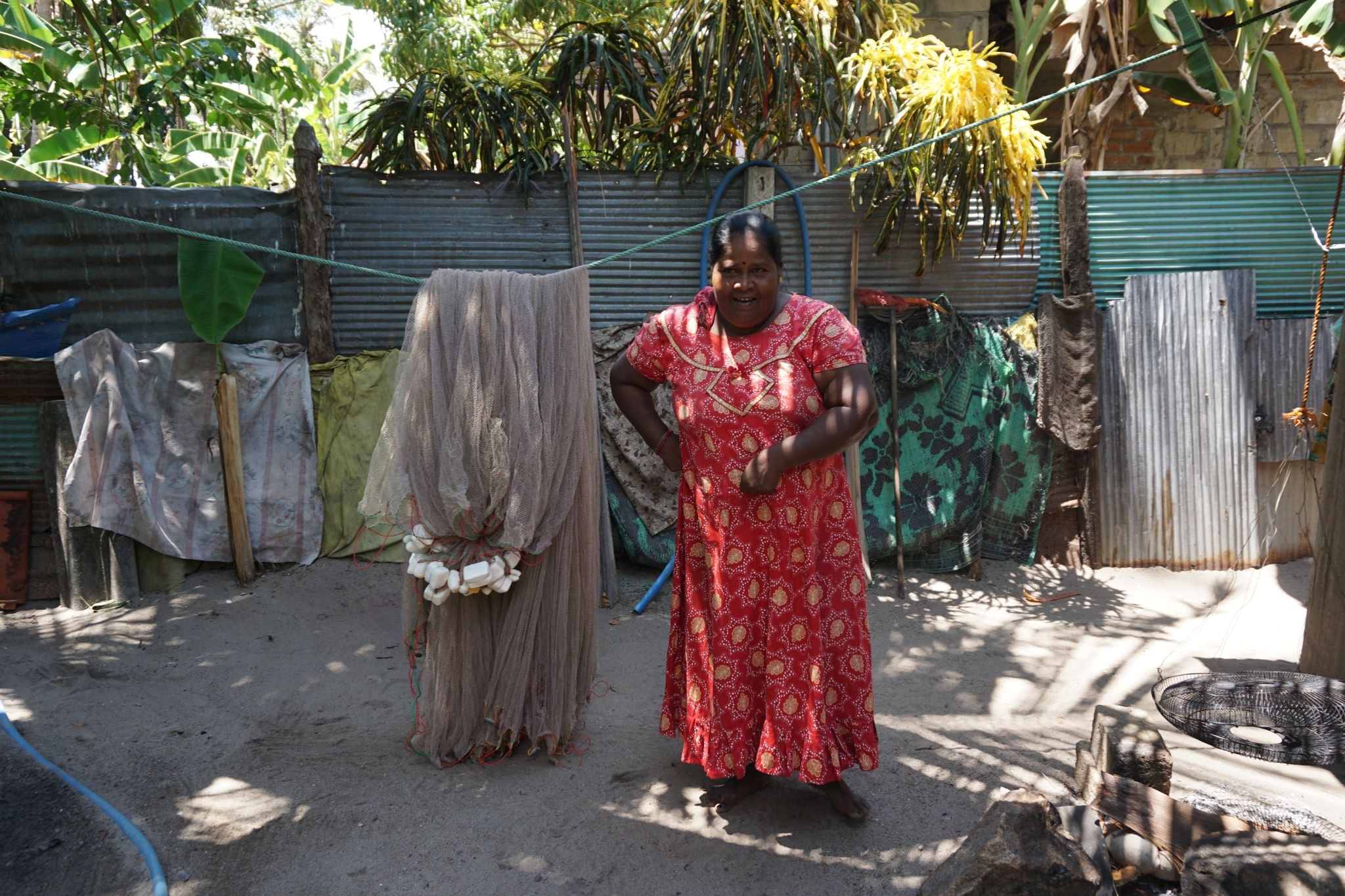
(Rathneshwary explains how to tie one end of the fishing net around her waist whilst fishing.)
In 2022, Sri Lanka plunged into a devastating economic crisis after defaulting on its sovereign debt, with the government declaring the nation ‘bankrupt’; in accordance with the requirements of the International Monetary Fund, Sri Lanka gradually implemented austerity measures. Three years on, macroeconomic indicators have shown a marked recovery, with GDP growth reaching 5.5%.
However, this has come at the cost of shrinking public welfare; inflation has doubled the price of essential goods, and basic social services such as education and healthcare are suffering from severe shortages.
A study published in 2025 by the International Food Policy Research Institute (IFPRI), a global research organisation specialising in food and agriculture policy, found that 32.8% of Sri Lankan households had experienced moderate or severe food insecurity in the 12 months before the survey, almost triple that of 2019 (12%). According to the survey of LIRNEasia, between 2019 and 2023, 4 million Sri Lankans fell into poverty, bringing the total number of people living in poverty to 7 million. Amidst the crisis, many have been forced to cut back on food and merely survive, just like Rathneshwary’s family.
Her story resonates with nearly 200,000 Sri Lankan women from North and East who have no choice but to support their families. The vast majority of them, having lost their husbands, fathers and brothers to war, have shouldered the responsibility of supporting their families; amidst the multiple challenges of natural disasters, global pandemic and economic crisis, they seek livelihoods, acknowledgements, solidarities and hope.
Rathneshwary lives in Batticaloa, the capital of Sri Lanka’s Eastern Province, and is one of over 300,000 fishermen in the province. Fishermen depend on the sea for their livelihood; fish are not only the mainstay of their diet but also the primary source of income for their families.
The Eastern Province is Sri Lanka’s second-largest province, boasting a coastline stretching for hundreds of kilometres and vast inland lagoon waters. These abundant water resources give the province a vital role in Sri Lanka’s agriculture and fisheries, with the vast majority of the population earning their living from farming, livestock rearing and fishing.
It is also Sri Lanka’s most religiously and ethnically diverse province; whilst Tamils form the majority at nearly 40 per cent, the Muslim (37 per cent) and Sinhalese (23 per cent) populations are also substantial. This diverse and balanced demographic composition once made it, in the eyes of many Sri Lankan intellectuals, an ideal testing ground for decentralisation, political progress and inter-ethnic coexistence.
The reality, however, is that ethnic-based politics have prevailed since Sri Lanka’s independence, putting the Eastern Province to the front line of ethnic conflict. Since the begining of the civil war, the people of the Eastern Province, regardless of ethnicity or faith, have endured protracted bombardments and the ravages of conflict. Even after the war ended, central government-led development policies have failed to establish sustainable livelihoods in rural areas, continuing to sow the seeds of instability within the country’s multi-ethnic political landscape. For ordinary people, every instance of what history notes as a word ‘conflict’ can result in years of displacement and hunger.
Habiba is 71 years old. For the past four decades, her fate and that of her entire family have been dominated by the narrative of their ‘Muslim’ identity. Habiba lives in the village of Mylampavely, 10 kilometres north of Batticaloa. Historically, the village’s Tamil and Muslim communities lived side by side in harmony. However, following the outbreak of the civil war, relations between the Tamils and the Muslims deteriorated sharply.
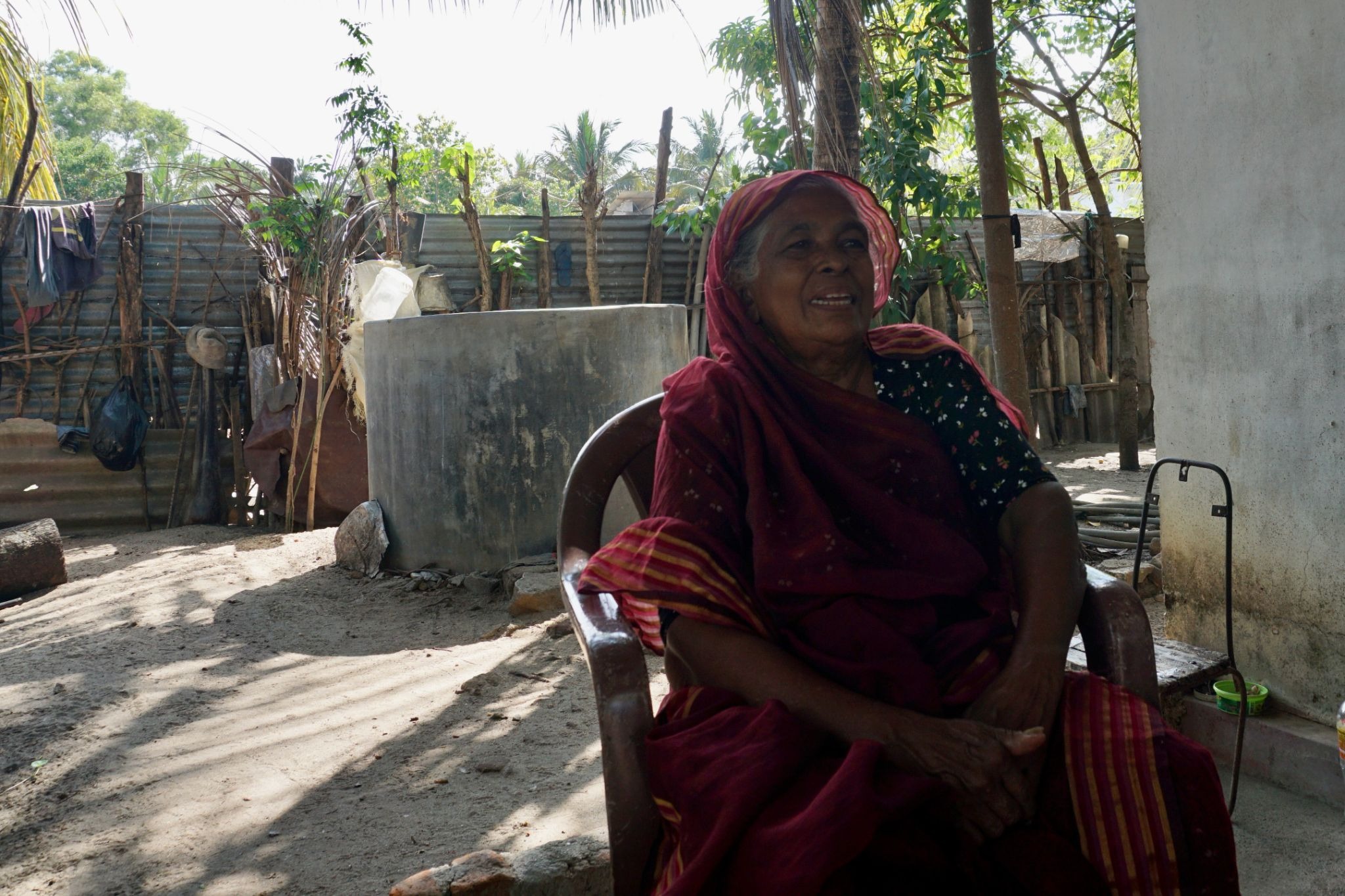
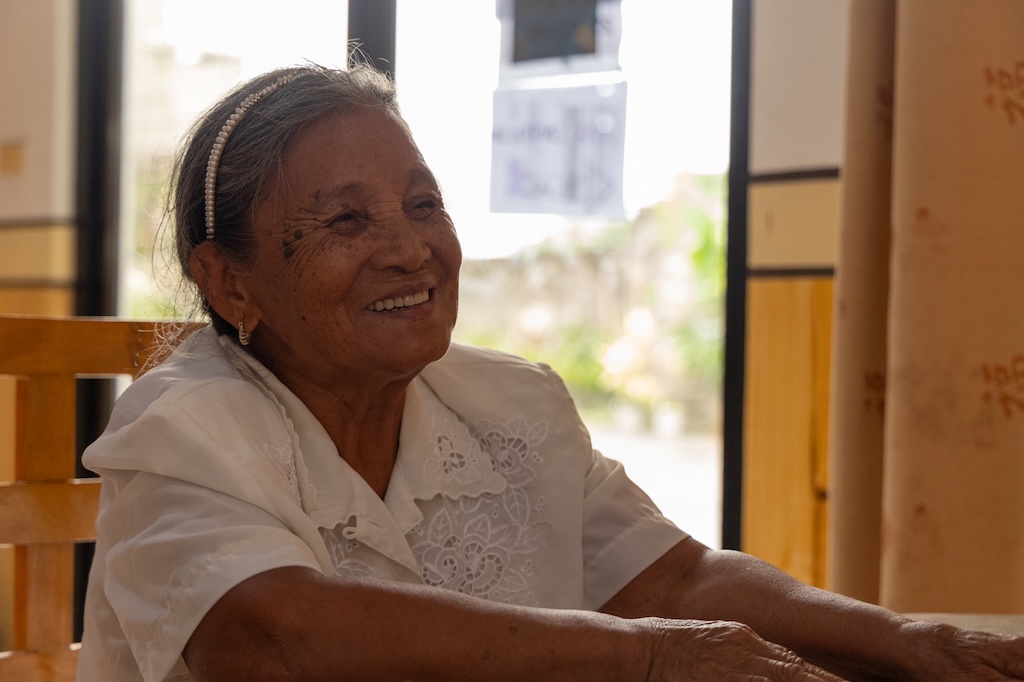
(Habiba’s fate and that of her entire family have been shaped by their identities as a ‘Muslims’.)
Although Sri Lankan Muslims and Tamils both speak Tamil, religious and ethnic differences have led to the formation of two distinct communities. Following Sri Lanka’s independence, the ruling party which upholds ‘Sinhalese-Buddhist supremacy’, continued to marginalise the Tamils, exacerbating tensions between the Tamils and the Sinhalese. The conflict escalated, and in 1983, Tamil militant groups in the North launched a civil war seeking for an independent state.
The Eastern Province was a natural extension of the Tamils’ vision for an independent Tamil Eelam. As Tamils in the region flocked to join the fighting, Muslims were forced into the conflict; both sides suffered heavy casualties, and hundreds of thousands were displaced, creating a deep rift.
Opinions vary as to the reasons behind this; the goverment alleges that Tamil militant groups took revenge on Muslims because they suspected Muslims of allying with government forces. Although some members of the Muslim community share this view, there are also voices, including those of some Muslim politicians, who believe that the escalation of tensions between the two sides has been driven by certain political forces within the government, and that there is evidence of the involvement of the national security forces.
When the conflict erupted in 1985, Habiba and her husband left the village with their three young children, moving from one refugee camp to another before settling temporarily in her husband’s hometown of Anuradhapura; they returned home six months later. She recalls that, under police coordination, an invisible dividing line was drawn through the village, separating Muslims and Tamils on opposite sides.
In 1990, following the breakdown of peace talks between the LTTE and government forces, the situation escalated once more. Habiba’s family fled again, taking refuge in a nearby Muslim religious school. A year later, when the school reopened, they were forced to move once more to the home of relatives in Anuradhapura. It was not until 2002, when both sides of the conflict agreed to a ceasefire and resumed peace talks, that they finally returned home.
Their former home had been razed to the ground, so Habiba and her husband erected a makeshift shelter using corrugated metal, roof tiles and palm leaves, and settled there. Her husband began working at a local pastry shop, whilst she looked after the household; life gradually stabilised, and their three sons grew into adulthood.
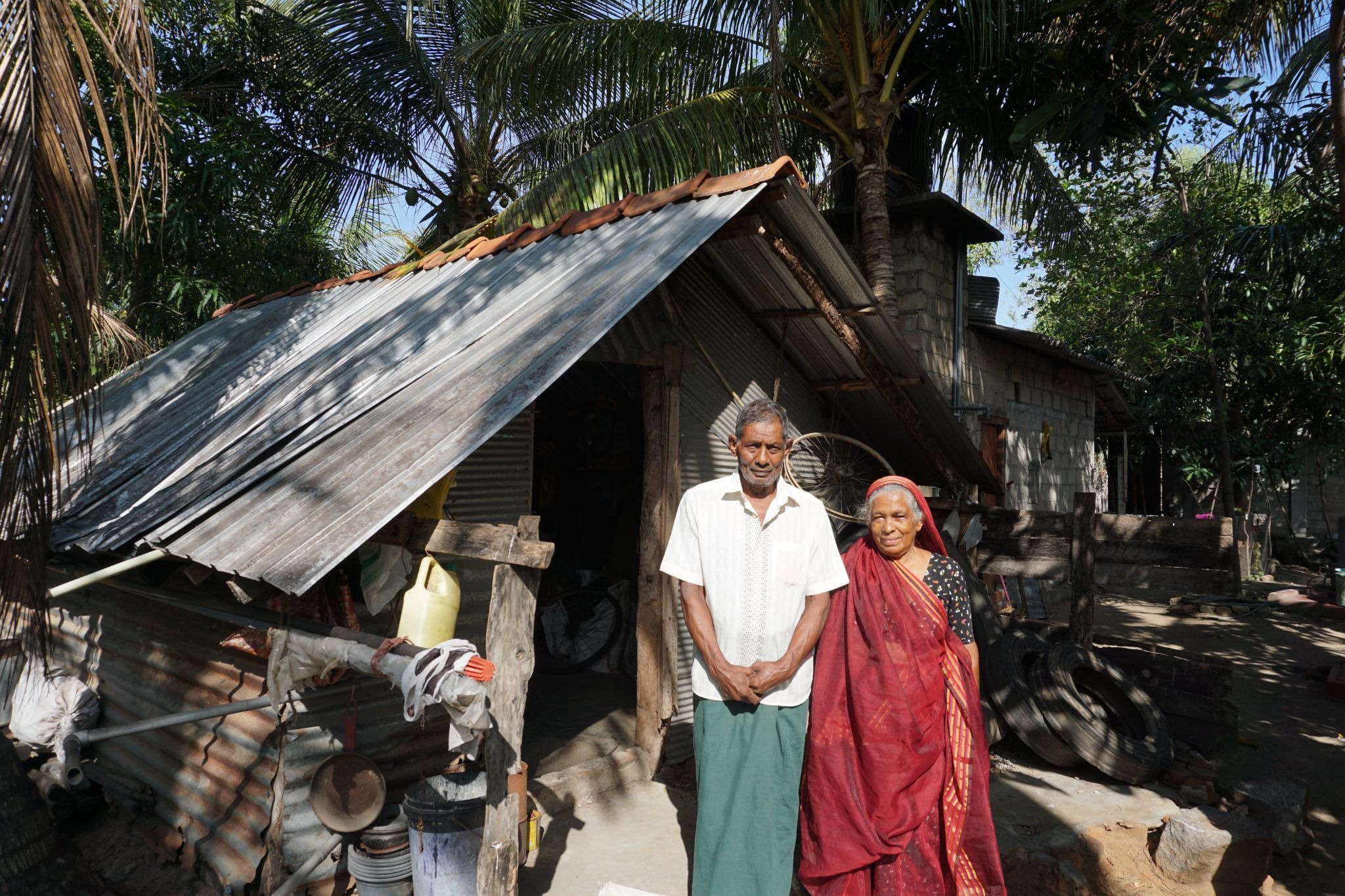
(Habiba and her husband, with the tin-roofed shelter they built upon their return in the background; the family lived there for over a decade.)
In 2015, Habiba’s husband was diagnosed with heart disease and had to stop working at the bakery. He began selling pastries by bicycle in nearby villages, whilst Habiba took on odd jobs making hand-woven crafts; the couple struggled. In 2018, her husband’s deteriorating eyesight meant he could no longer go out to sell pastries.
Things got even worse a year later. On Easter Sunday 2019, several churches and luxury hotels in Sri Lanka were hit by terrorist attacks, claiming 269 lives. Habiba’s life was once again transformed by her identity as a ‘Muslim’.
‘For us, the economic crisis began with the Easter attacks in 2019,’ said Habiba. After the attacks, tensions between Muslims and Tamils flared up again, and she was unable to go to the Tamil neighbourhoods to sell the palmyra mats she had woven. Without an income, she and her husband found themselves struggling to make ends meet. This was followed by the COVID-19 pandemic in 2020 and the economic crisis in 2022.
Since then, Habiba and her husband have been living on a monthly government subsidy of 7,500 rupees and the income from her palmyra mat sales. The glass display case her husband used to sell snacks in still stands in the courtyard; Habiba keeps it polished to a shine.
They can no longer afford beef or chicken; they buy fish twice a week, and the rest of the time they eat vegetable curry with rice. Like many others, they have got used to eating only two meals a day. Fortunately, they keep a few hens at home, so they have enough eggs to eat and can even sell the surplus.
Habiba pulled an egg from the cardboard box, which she uses as a chicken coop, pointed to the dried leaves drying on the ground, and told us with a smile, ‘These are dried cassava peels. Sulochana gave them to me; I use them to feed the chickens.’
Sulochana lives on the Tamil side of the village; her eldest daughter makes crisps from cassava, and the peels she peels off are given to everyone to feed their chickens.
Like many fisherwomen who grew up by the lagoon, Sulochana has spent most of her life dealing with the fish in the lagoon. Her family makes a living from fishing; fish are not only the main dish on the table, but also the family’s primary source of livelihood.
As the eldest daughter of a fishing family, Sulochana began accompanying her father to the lake to fish before she turned ten years old. ‘My father would wade into the lake and stand in water up to his waist to cast his net. I would stand beside him, holding the bag for the fish or helping him put the catch inside,’ she says.
Later, her father built a small wooden canoe himself, and Sulochana would accompany him out onto the lake to fish. Having grown up close to the lagoon, she gradually observed the rhythms of the tides and mastered the art of fishing. With five younger siblings still very young, her mother looked after the children and the household chores, whilst she and her father took up the responsibility for feeding the family.
After the war and the turmoil, it was the fish in the lagoon that enabled the fisherwomen to rebuild their lives. In 1990, Rathneshwary’s husband and younger brother went missing during the conflict; eight months pregnant, she fled her home with her parents and took refuge in a refugee camp.
A year later, she returned to her shattered ‘home’ with her parents and her son, who had just turned one. She accompanied her father to fish in the lagoon, setting out at night and returning the following morning, earning six or seven thousand rupees each time. A house was built, and with fish, eggs and vegetables all produced on their own land, they had no worries about their three daily meals.
Yet over the past three years, the nutritious diet they once took for granted has become a luxury. The double blow of the economic crisis and climate change has hit small-scale fishermen like them hardest, with the most immediate impact being a reduction in food.
To save money, Sulochana’s family’s lunch consists of nothing more than rice and a single curry, sometimes made with home-grown vegetables, sometimes with mashed palm fruit. Only if her husband brings home fish from his work can they eat fish. Breakfast and dinner are vegetable porridge or leftover rice; they eat whatever is available, just to fill their stomachs.
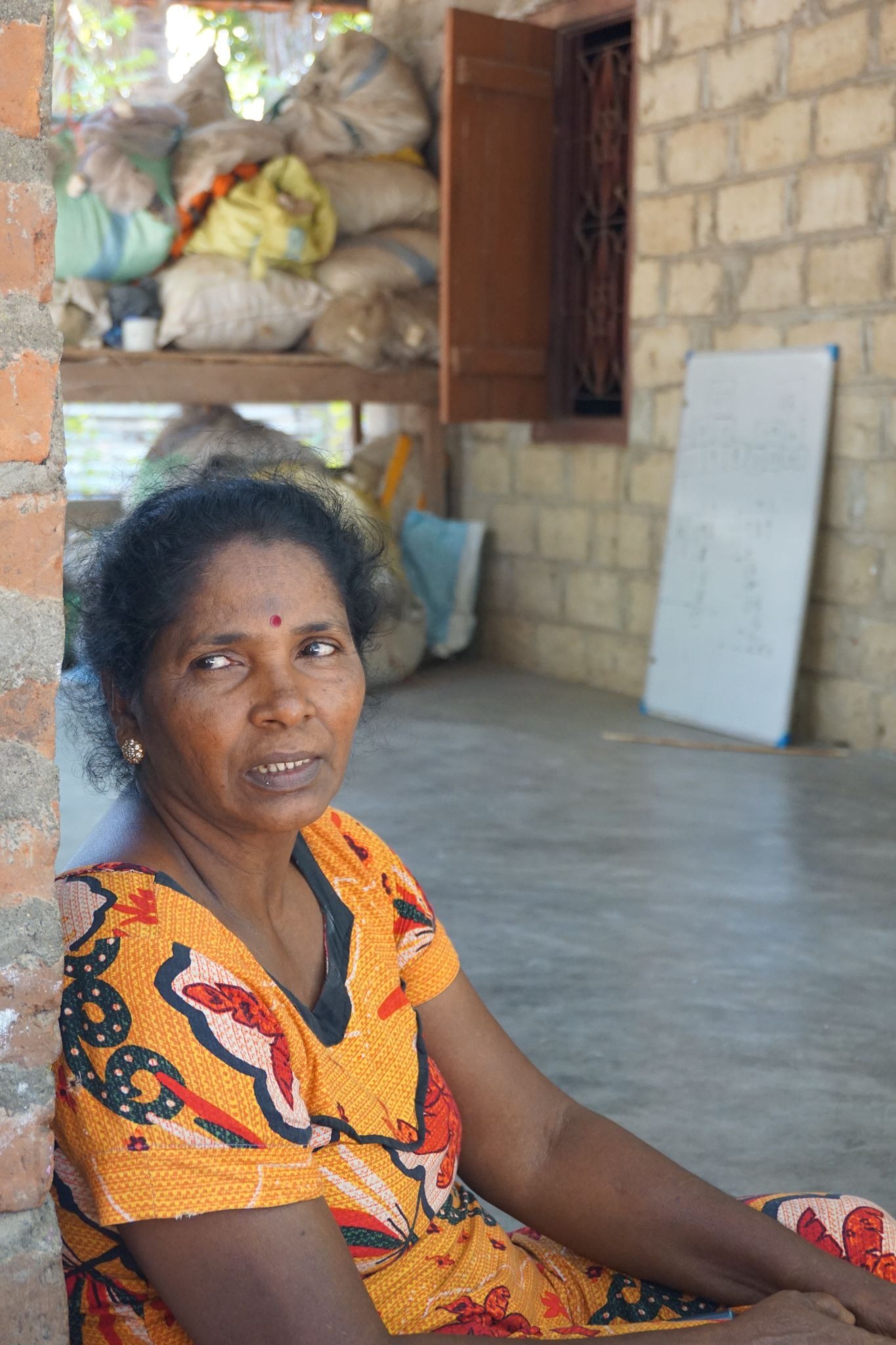
(Sulochana used to be a teacher; she uses the whiteboard at home to help her granddaughters with their homework.)
Sulochana recalls that, in the past, their family lunches always included a mix of meat and vegetables, typically with three or four side dishes: vegetables, lentils and fish; they could also afford to buy chicken at least once a week.
The vast lagoon has provided generations of fishermen with an abundant catch. The fishermen follow the rhythms of the climate and the lagoon’s ecology, passing down their ancestors’ fishing techniques from one generation to the next. Sulochana explains that small-scale fishermen like herself always plan their fishing around the seasons: January to April is the peak season, when the catch is plentiful; once the monsoon arrives, the catch diminishes.
‘When the catch is sufficient, we dry some of the fish and preserve it as salted fish. Later, during the off-season, the dried fish can be used to make curry or sold for money,’ she told me.
However, the deterioration of the ecological and economic environment has made it difficult to sustain this traditional livelihood. The cost of living has doubled or tripled, whilst the catches of small-scale fishermen have plummeted. On the one hand, frequent extreme droughts and severe floods have disrupted the lagoon’s ecology and fishing cycles; on the other hand, illegal fishing is becoming increasingly rampant. Although the government banned destructive fishing methods such as gillnetting long ago, the illegal activities of some are condoned by local officials.
‘Nowadays, illegal fishing is becoming increasingly severe, and we can no longer catch as many fish as we used to,’ she said. The fine fishing net sweeps up young fry, disrupting the fish population’s reproductive cycle, and fish stocks have plummeted.
‘Everything is slowly being destroyed, life has become extremely difficult for people like us,’ Sulochana told me. Two months ago, her fishing nets in the lake were dragged away by a large trawler; not only did she fail to retrieve her catch, but her nets were also torn. As they have no money to repair them, she and her husband are unable to go fishing anymore.

(With no money to repair the nets, Sulochana’s nets are temporarily piled up in the yard.)
Left with no choice, her husband has returned to working for a fishing crew. The employer pays the workers according to the day’s catch; sometimes he receives a share of the fish and a few hundred rupees, and at other times, he brings home nothing but some small fish.
Amidst this looming crisis, it has become increasingly difficult for the fisherwoman to eke out a living from the lagoon as she once did, to find the strength to endure and bounce back from adversity.
In 2020, Rathneshwary’s father passed away from a heart attack; the ensuing economic crisis proved to be the final straw, bringing the family to its knees. The cost of living has doubled; rice that used to cost 900 rupees per kilogram now costs 2,000 rupees; her mother is getting older, and medical expenses are a significant burden. The fishing nets that once sustained them now spend most of their time drying in the courtyard, whilst she and her mother supplement their income by weaving palmyra mats.
‘Who can afford to buy fish these days?’ asks Rathneshwary. She now catches fish only for her family’s consumption, and any surplus is dried and stored.
In the view of many scholars and social activists, the plight of Sri Lanka’s tens of millions of smallholder farmers and fishermen during the crisis is the inevitable result of policy misalignment and systemic failure.
Around half of Sri Lankans make their living from agriculture and fishing, the vast majority of whom are small-scale producers. After independence, they formed a key electoral base for political parties and consequently received strong policy support. However, from the late 1970s onwards, Sri Lanka implemented economic liberalisation and structural adjustment, which accelerated in the 1990s under the impetus of the World Bank and the International Monetary Fund. ‘The World Bank report Sri Lanka Nonplantation Crop Sector Policy Alternatives that came out in 1996, is one of the key documents that pushed for a large-scale industrial agriculture to replace the small-scale food production.’ Sandun Thudugala, Director Programme and Operations at Law & Society Trust, says.
The country committed to establishing an export-oriented economy based on intensive agriculture, whilst the deemed ‘inefficient small-scale producers’ were supposed to be absorbed as labourers by factories, plantations and farms as urbanisation progressed. Subsequent agricultural policies have continued to follow the same logic, a model that Sandun views as a complete failure.
‘Look at the example of tea plantations: we have large-scale plantations, and our tea exports hold a place in the global market, yet plantation workers are among the most marginalised and impoverished groups in the country,’ said Sandun.
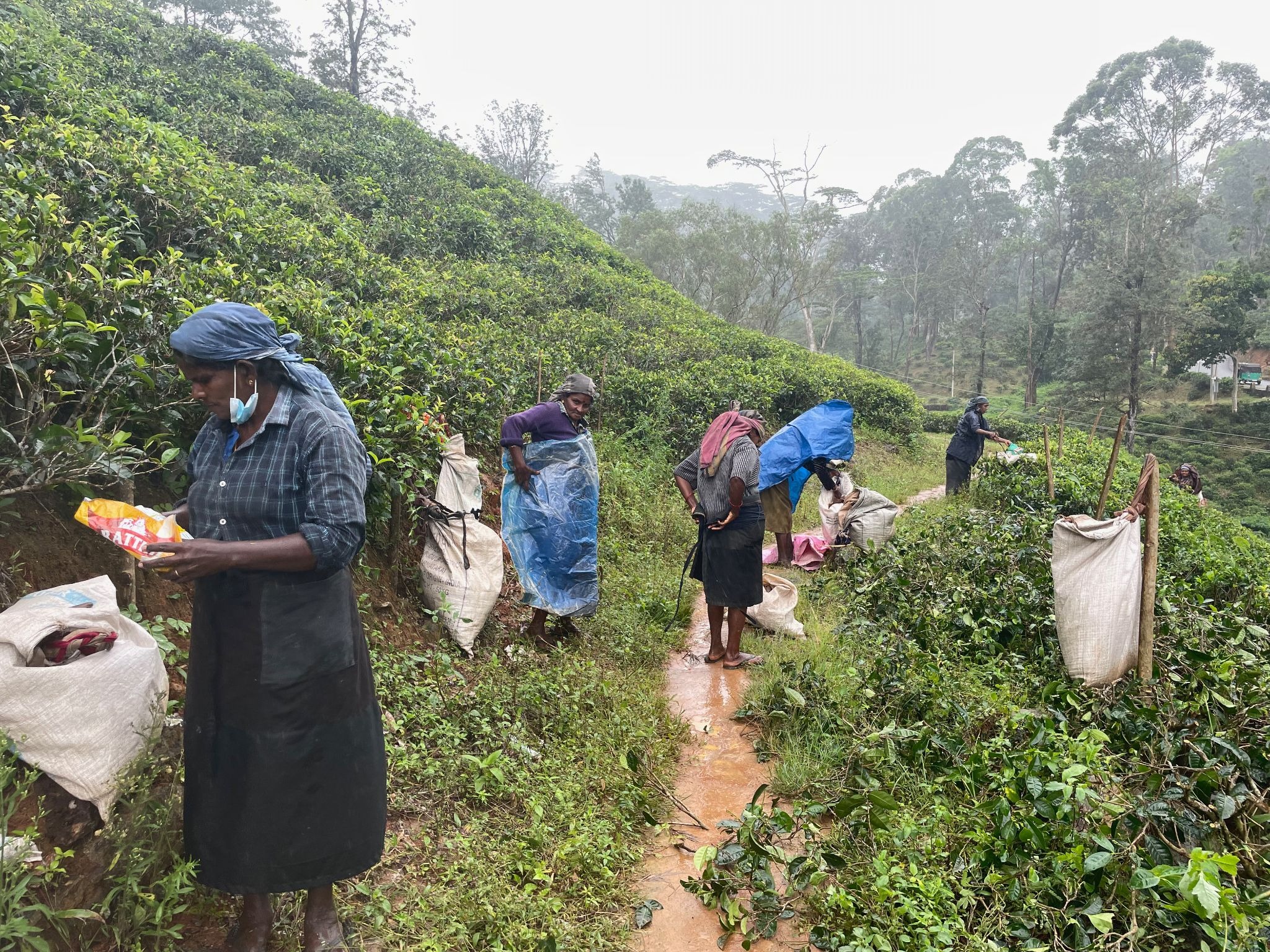
(Tea pickers in the high-altitude tea estates of Sri Lanka.)
He believes that the rapid urbanisation and industrialisation envisaged by the World Bank have failed to materialise. The collapse of the local agricultural production system, caused by policy misalignment, will lead to even greater humanitarian disasters as the country faces wave after wave of shocks, including natural disasters, the COVID-19 pandemic and international instability.
In the Eastern Province, post-war land disputes and the loss of male labour have placed women on the front line of the struggle against economic and environmental crises.
On 28 November 2025, Cyclone Ditwah swept across the east coast of Sri Lanka. Severe torrential rain and flooding claimed the lives of more than 600 people, left 200,000 homeless, and affected a total of 1.8 million people.
When the floods strike, no one is spared. In Batticaloa, ‘flooding’ has become an accepted inevitability. The Mahā northeast monsoon, which runs from November to January, is traditionally the season for rice sowing and growth; yet in recent years, it has turned into a recurring ecological disaster. Traditional farming has become unsustainable and may even result in the loss of property and lives.
49-years-old Vijarany owns one and a half acres of land. Through farming and livestock rearing, her family used to lead a self-sufficient life. They grew several varieties of vegetables, coconuts and sugarcane on their land, and kept some cows and some hens at home. The cows provided milk and were used to plough the fields, whilst the home-grown vegetables and eggs were more than enough to provide the family with sufficient nutrition.
She and her husband worked hard to raise seven children. Cow dung served as a natural fertiliser, and seeds were saved from previous harvests for the next sowing season. Any surplus milk, eggs and vegetables could be sold at the family-run grocery shop, generating enough income to support the household.
However, two years ago, her husband was diagnosed with cancer and passed away shortly afterwards. Due to flooding, their vegetable patch for that season was also washed away, leaving them with nothing. The two youngest children are still at middle school, and the eldest son has no interest in farming; he has taken up welding work. Vijarany, unable to cope on her own, sold the cows and let the vegetable patch lie fallow.
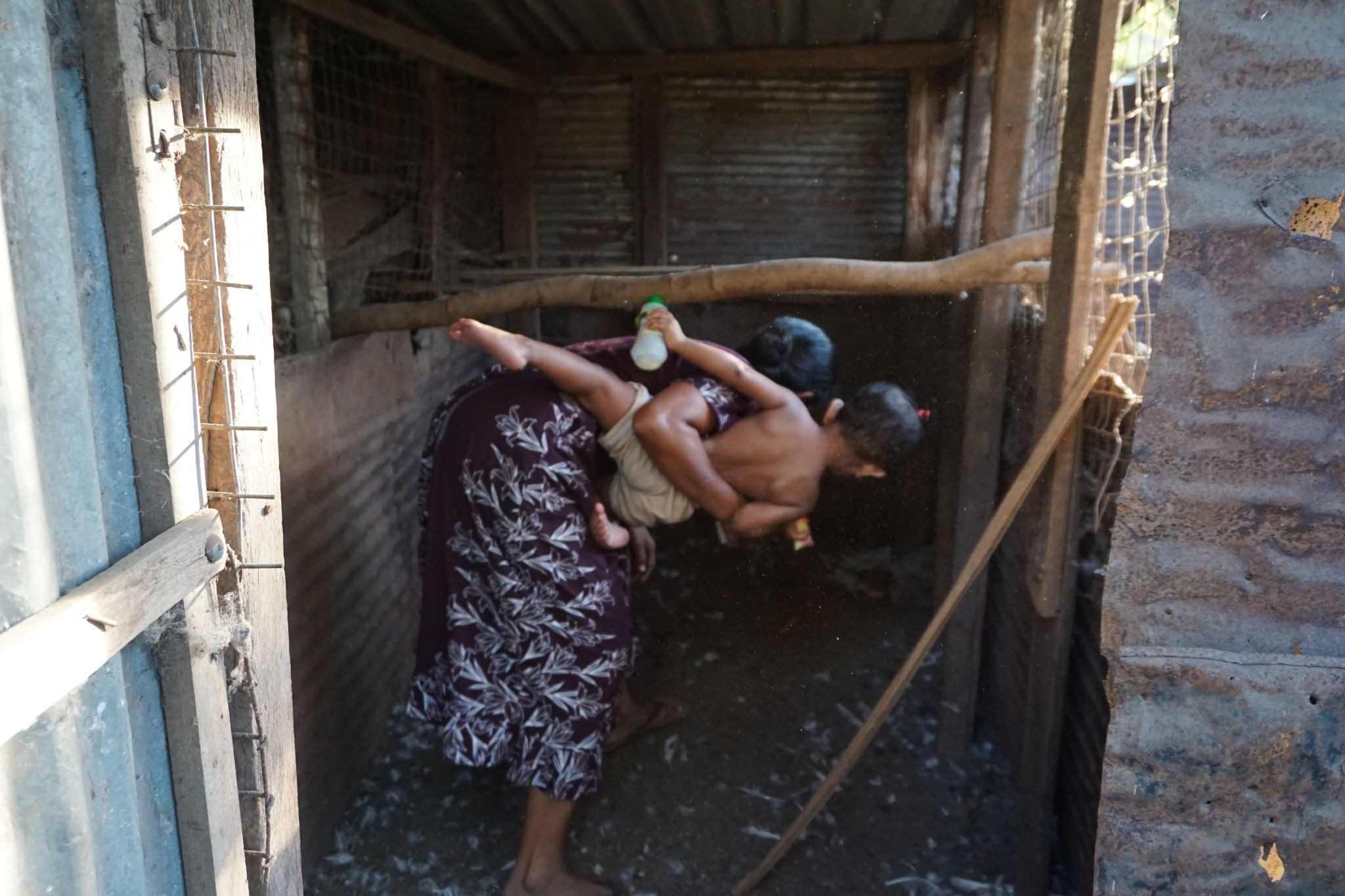
(Vijarany, holding her granddaughter, bends down to collect eggs from the henhouse.)
‘There are floods every year; you simply can’t make a living from farming, and none of the children wants to carry on,’ she says. Since her husband’s death, she has been living with her eldest daughter, helping to look after her two young granddaughters while continuing to run the small grocery shop.
Apart from everyday groceries, she can now only earn a little income by selling eggs. Holding her granddaughter in her right arm, she bends down and deftly retrieves two eggs from the henhouse with her left hand. She breathes a sigh of relief; sometimes, if she doesn’t collect them in time, the eggs get eaten by rats.
The collapse of traditional livelihoods has pushed more farmers and fishermen into the abyss of predatory loans and debt trap. The Eastern Province is one of Sri Lanka’s largest sources of migrant labour, residing far away from home, workers often have to pay exorbitant agent fees, trading their sweat and freedom for wages.
Faced with livelihood challenges, women of different religions and ethnicities have come together in adversity, gradually realising that climate disasters and economic crises are their common enemies.
Although the Tamil Sulochana and the Muslim Habiba live in the same village, their families were not close from the start. A long history of bloody conflict has etched fear into the bodily memory of their generation. The 2019 Easter attacks further exacerbated Islamophobia across the country.
Ahilan Kadirgamar, a senior lecturer in sociology at Jaffna University, believes that, beyond the political sphere, grassroots development in eastern Sri Lanka lacks institutional frameworks at the community level. This has led to conflicts between Tamils and Muslims over resource allocation, sowing the seeds of potential discord in inter-ethnic relations.
Sulochana and Habiba first met at an event organised by the Suriya Women’s Development Centre. This grassroots organisation is dedicated to women’s development; at its meetings and events in Suriya, Muslim and Tamil women who would normally keep their distance have come to know one another and have even gradually grown closer.

(Women chatting in the courtyard of the Suriya Women’s Development Centre.)
‘At first, we [Muslims and Tamils] wouldn’t eat together, and we were even a little afraid when we first joined the programme, because we often heard hateful remarks directed at each other,’ Habiba said.
Suriya provided them with a safe space. She told me that at Suriya, everyone had the opportunity to discuss the root causes of community conflict together. ‘We realised it wasn’t us, but others who were causing it,’ she said. As they got to know one another, they gradually began to let down their guard, and she is now frequently invited to weddings and temple festivals.
At the Suriya’s community centre in the Mylampavely village, a small agricultural cooperative is taking shape. In the courtyard, there is a small vegetable patch where tomatoes, chillies, aubergines and other vegetables are grown, with each seedling planted individually in a plastic bag.
This is a method devised by the women themselves; should flooding strike, the plants can be moved to higher ground, ensuring they do not lose their entire harvest. On the other side of the courtyard lies the fertiliser they have produced using traditional ecological composting methods, as well as a ‘seed bank’ from which members can freely take and exchange seeds.
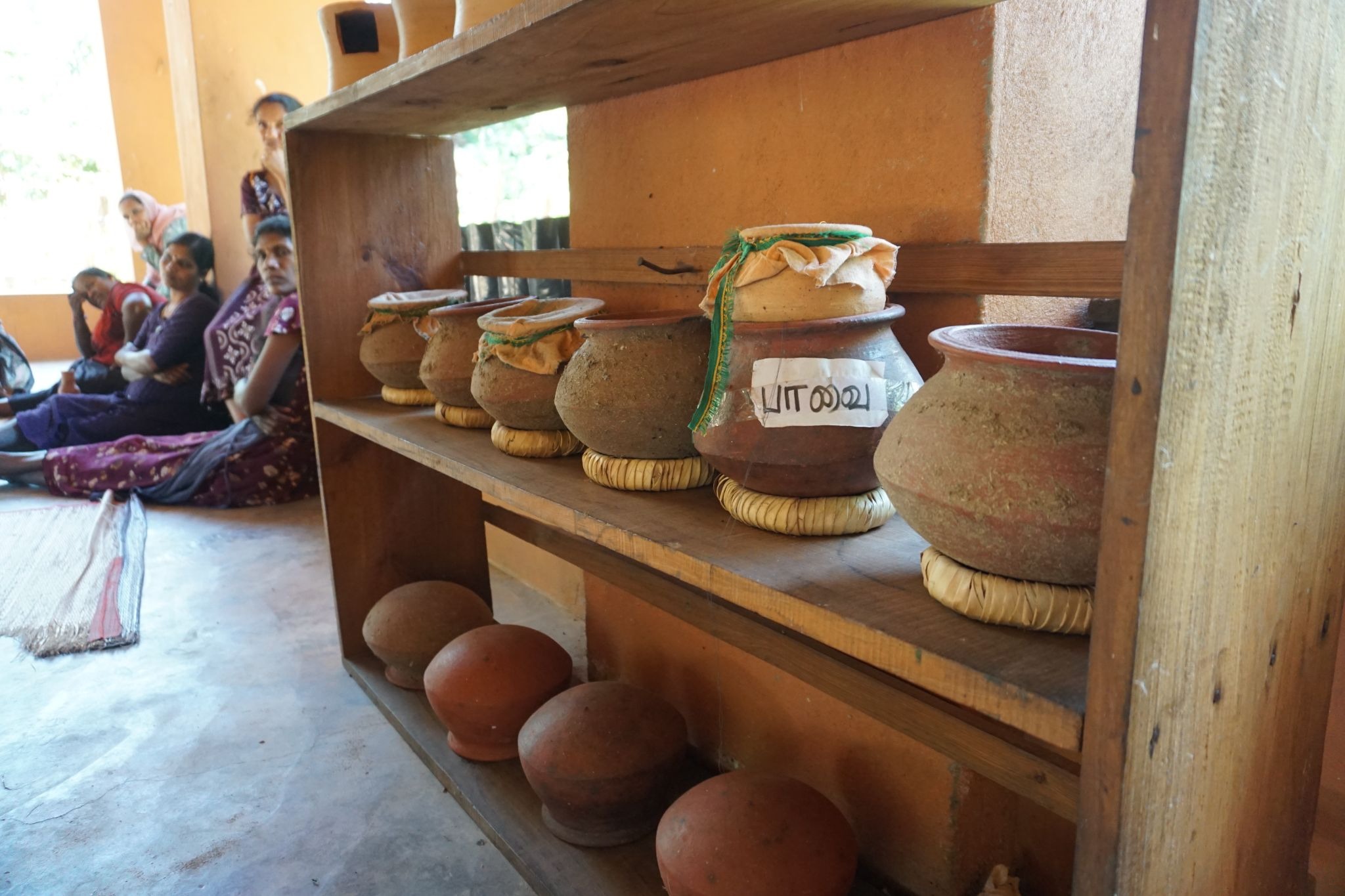
(The ‘seed bank’ at the Suriya’s community centre.)
The community vegetable garden is part of Suriya’s response to the food crisis. The COVID-19 pandemic served as a wake-up call, making the women realise that their traditional subsistence livelihoods had been supplanted by an industrialised food system, and that their sovereignty as food producers was severely threatened.
‘Previously, we were extremely reliant on agricultural distribution centres in places like Dambulla for our vegetables and grain. During the pandemic lockdowns, transport and trade ground to a halt, and we couldn’t buy anything. It was then that more people began to realise just how important it is to grow a few vegetables and chillies at home,’ Elangeswary Arunasalam, Programme Coordinator at the Suriya Women’s Development Centre, told me.
The ensuing economic crisis left many facing severe food shortages and malnutrition. Members of Suriya spontaneously organised community canteens, with women pooling rice, coconuts and other ingredients from their homes to cook a large pot of thin porridge daily, adding wild greens, vegetables and whatever food they could find.
A small cup of porridge provided everyone with the basic nutrition their bodies needed for a meal. They would sit together to eat, and the leftovers were distributed to other villagers; the women also shared and exchanged ingredients with one another.
The normalisation of the economic crisis prompted Suriya to build on this foundation by launching further awareness-raising activities on nutrition and food sovereignty. Following a research trip to Mullaitivu District, local women organised themselves to prepare over 40 varieties of nutritious traditional dishes using ingredients such as millet, maize, cassava, taro and coconuts, many of which had gradually disappeared from the daily lives of the younger generation.
‘It is very important that these traditional dishes were prepared by young women. This was a meaningful opportunity. They learnt traditional recipes from their elders at home and, through intergenerational exchange, reconnected with their cultural heritage,’ Elangeswary told me.
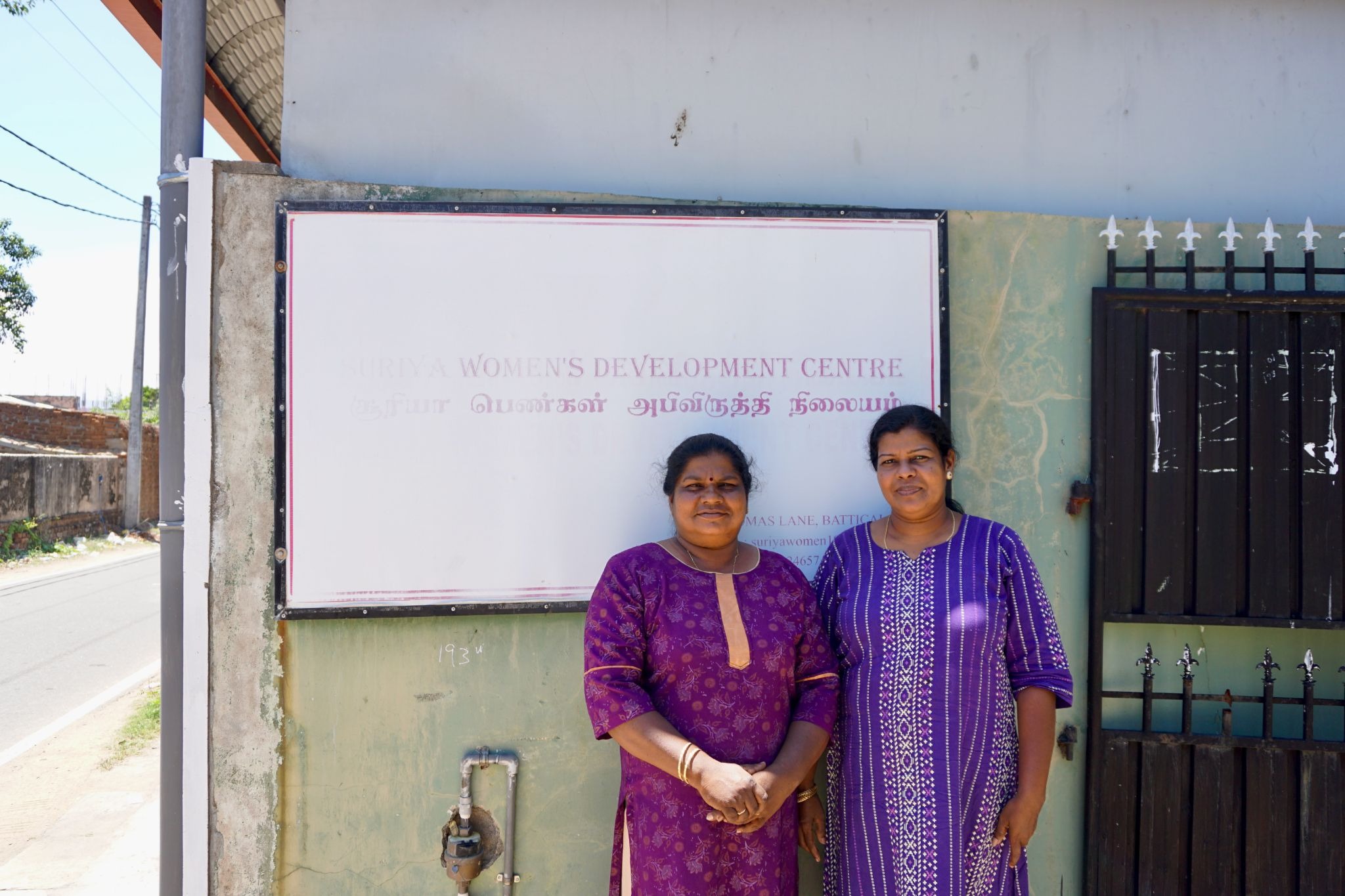
(Elangeswary [right] and Rabita at the entrance to the Suriya office)
In an industrialised food system, convenient and quick imported foods, such as bread and baked goods, have gradually replaced the traditional dietary system. This not only places farmers, as food producers, in a vulnerable position within the capital market and jeopardises food security, but also poses certain health risks. She explains, ‘In some cases, people even sell milk to buy products like Milo or biscuits, which are of significantly lower nutritional value.’
The food crisis triggered by the COVID-19 pandemic and the economic crisis also presents an opportunity to reflect on food industrialisation and return to local food systems. Suriya is using this as an opportunity to continue advancing its ‘home gardening’ project. By distributing seeds, vegetable seedlings and fruit tree saplings to women, Suriya aims to address long-term food security and ensure sustainable livelihoods. This is the methodology Suriya has gradually developed over the past three decades.
Elangeswary joined Suriya in 1997. Initially, their work focused primarily on organising, mobilising and awareness training. Following the 2004 Indian Ocean tsunami, Suriya began providing women with essential supplies and modest financial assistance.
‘But we soon realised that direct financial aid did not solve long-term development issues, so we began to investigate the specific root causes,’ Elangeswary explains that Suriya first focuses on the community’s existing resources and the women’s current livelihoods. For instance, as many women earn money by hand-weaving palmyra products, the organisation supports them in planting palmyra trees, thereby eliminating the need to purchase materials and transforming these resources into a sustainable source of livelihood through cultivation.
In its livelihood projects, Suriya does not provide large amounts of direct financial aid. Instead, it selects 40 to 50 women at a time to provide training and run pilot schemes. For those women who demonstrate strong commitment and high levels of engagement, the organisation provides partial financial support and encourages them to contribute the remaining funds themselves. This approach helps women break free from dependence on external aid and creates a virtuous cycle of self-sufficiency.
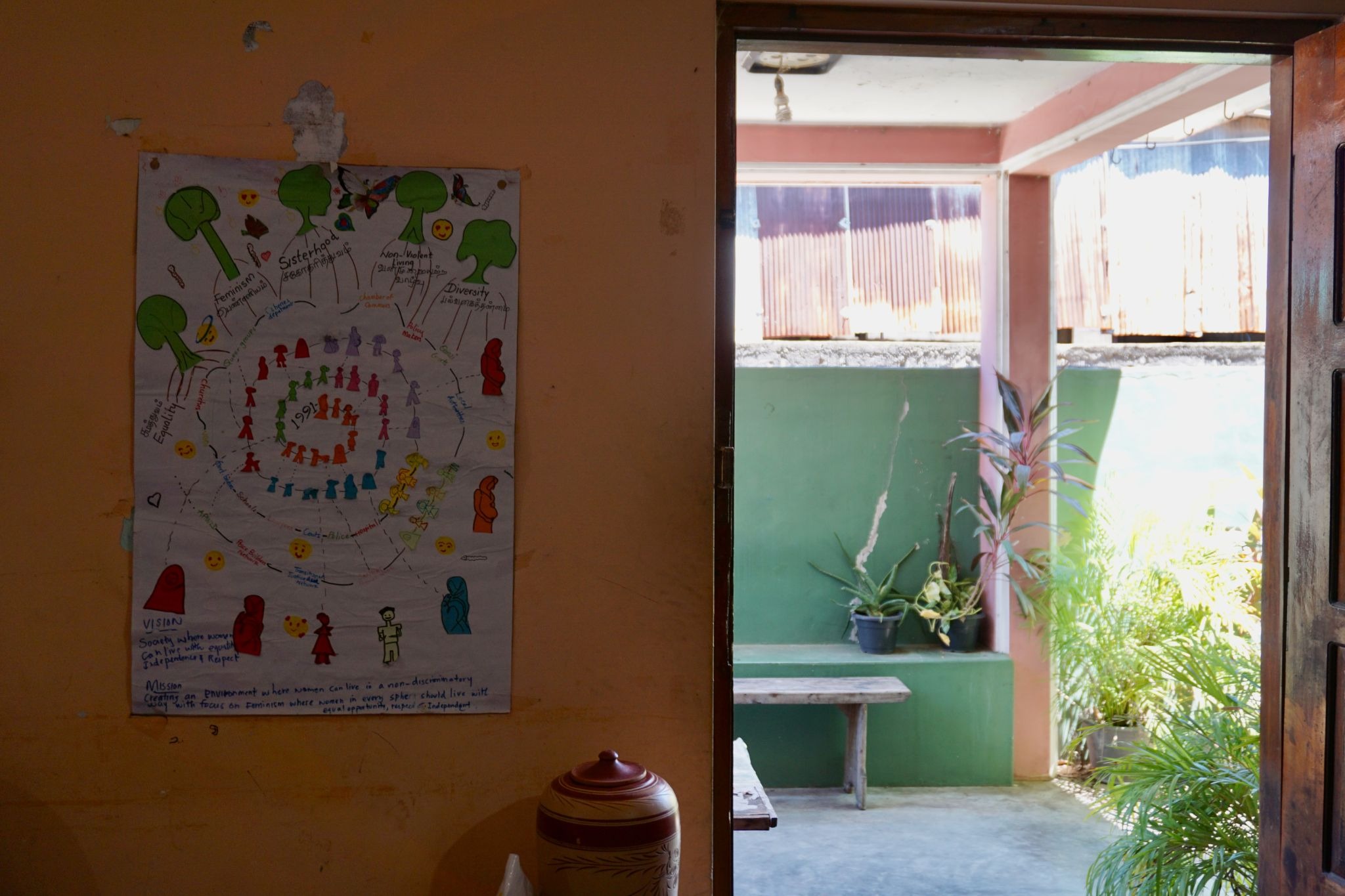
(A painting of a ‘feminist ecosystem’ in Suriya’s office.)
At the same time, they also support women in exchanging ideas with other ecological agriculture organisations to learn about organic farming knowledge and techniques. ‘Our future goal is to find a larger plot of land for collective ecological farming, applying the self-sufficient model of cultivation, harvesting, composting and seed recycling on a larger scale. The harvested grain will be enough for everyone to eat, and any surplus can be sold,’ says Elangeswary.
She explains that traditional farmers’ cooperatives are dominated by male farmers, with some even barring women from joining, leaving them unable to access agricultural networks, subsidies and benefits. At the same time, modern agriculture is driven by yield and economic returns, relying heavily on industrial fertilisers, whereas women often grow crops primarily for their own consumption, making ecological agriculture a more appealing option for them.
Similarly, Suriya established the Eastern Province’s first women’s fishing cooperative in Batticaloa, enabling female fishermen to share knowledge and tools, support one another and fish together.
The Old Kallady Bridge, built during the British colonial era, is Sri Lanka’s oldest and longest iron bridge. Spanning the Batticaloa Lagoon, it serves as a vital transport link connecting the eastern and western parts of the city, as well as a significant cultural symbol — according to local folklore, in full-moon night, schools of fish gather beneath the bridge, emitting a sound akin to singing.
On the footpath beside the bridge lies a small agricultural market called ‘Natural Farming’. The market sells ecological agricultural and fishery products produced by women, including vegetables, fruit, ghee, peanuts, dried fish and coconut products. These women come from the town of Vakarai, over 60 kilometres from the city. They are all members of a local women’s agricultural cooperative, which has 32 members in total. They take turns coming to the market to run their stalls, while those who stay at home help one another by tending to the fields and looking after the children.
The stalls also sell pure, natural honey, which they sell on behalf of the indigenous people living in the local forests. The journey to the city to set up their stalls is a long one, requiring a two-hour bus ride; the women set off at 5 o’clock every morning and do not return home until after 4 in the afternoon. Earnings are reasonable at weekends, but on weekdays, there are few customers, and sometimes they can barely cover their transport costs.

(Women from Vakarai selling produce at the market on the Old Kallady Bridge.)
‘Natural Farming’ is a women’s livelihood development programme supported by organisations such as World Vision. Like Suriya’s experiment, it is dedicated to addressing the interrelated issues of food sovereignty, women’s livelihood development and environmental sustainability.
A women-led agricultural revolution is quietly taking place. In Sri Lanka, there are many organisations that share their vision, such as the Wellassa Women’s Organisation in the Uva Province. During the pandemic, they collectively practised ecological farming, providing sufficient food and vegetables for their families and communities, ensuring that no one went hungry. MONLAR is an organisation that advocates for farmers’ movements and food sovereignty. It collaborates with agricultural organisations across the country, supporting projects led by women’s groups, such as ecological farming, alternative marketing systems and community credit schemes, through mobilisation, capacity building and skills training.
St Sebastian’s Church, located on the southern side of the Old Kallady Bridge, is another iconic stronghold of the Batticaloa women’s movement. Every morning at 9 o’clock, women from across Batticaloa gather here and walk in a line to Gandhi Park, three kilometres away.

(‘Batticaloa Justice Walk’ was launched in 2022 amidst Sri Lanka’s economic crisis and has now been ongoing for nearly four years.)
Holding placards, they raise their voices for those killed, injured or missing in the war, for farmers struggling to survive the economic crisis, and for women and children in distant Palestine. Neither scorching sun nor wind and rain can halt their steps; over the past 1,400-plus days, ‘Batticaloa Justice Walk’ has been missed for just one day due to severe flooding.
(This story is supported by Asia Pacific Forum on Women, Law and Development [APWLD]’s Feminist Media Fund for Alumni)