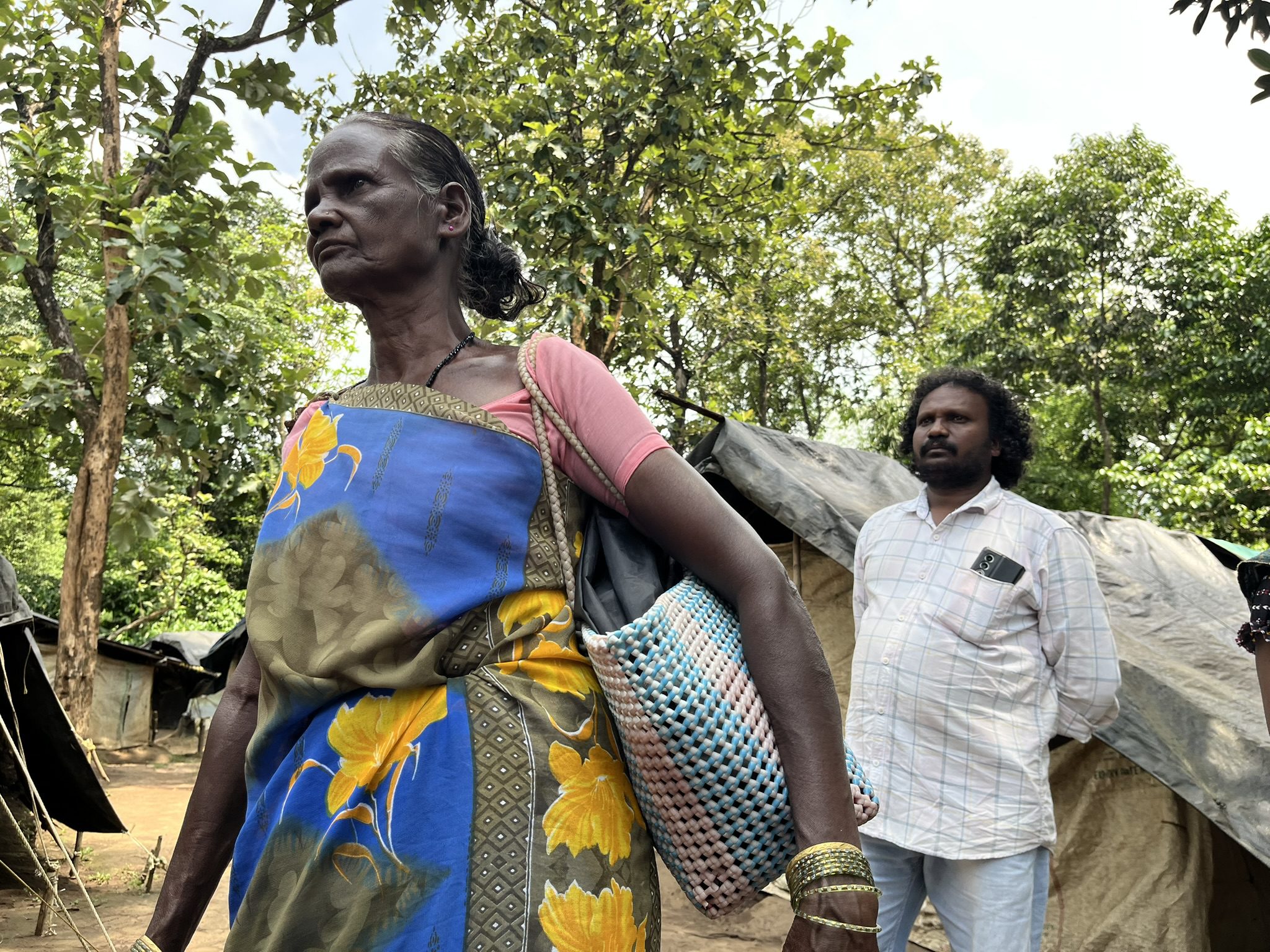
Continuing with their demand for recognition and claims to their ancestral lands, different tribal communities in Karnataka’s Nagarahole took out a padyatra (march) demanding their rights, including the stoppage of the Tiger Safari that the community claims is illegal.
A small group of Adivasis from 52 haadis (tribal villages), led by the Nagarahole Adivasi Jamma Paale Hakku Sthapana Samiti (NAJHSS), walked over dozens of kilometres and covered 29 villages in Kodagu and Mysuru districts to assert their rights to their ancestral lands in the Nagarahole forests.
Speaking to Maktoob, J.A. Shivu, president of the Karadi Kallu Forest Rights Committee (FRC), said that the yatra was a way to raise awareness about the recognition and enforcement of their rights under the Forest Rights Act (FRA).
“There are many issues against which we conducted the yatra. One major reason was to raise awareness on the community rights claims. Another issue is the tiger safari that is being carried out on our ancestral lands without the consent of the Gram Sabhas, because there has been no recognition of community forest rights in any of the villages inside Nagarahole,” he said.
NAJHSS had announced a historic awareness foot march regarding the Forest Rights Act, 2006, in the traditional lands of the Jenu Kuruba, Beta Kuruba, Yerava, and Paniya Adivasi communities residing in the Nagarahole region.
This foot march commenced on December 21, 2025, from Thitimathi Aiyrasuli village in Kodagu district and, passing through the villages of the Nalleri forest region, covered a distance of approximately 70 km and reached Bavali in H.D. Kote taluk of Mysuru district.
Along the route, Gram Sabhas were conducted in many villages under the Forest Rights Act, 2006. Awareness was created about the Act, and discussions were held regarding its non-implementation and violations in the forest areas of Nagarahole, declared as Rajiv Gandhi National Park and Tiger Reserve.
Tribal communities, primarily the Jenu Kuruba, in the Nagarahole Tiger Reserve are in a prolonged conflict with forest authorities, fighting for their ancestral land rights, demanding the implementation of the FRA, and protesting forced evictions and what they perceive as “colonial conservation” models that displace them for wildlife preservation.
Maktoob had earlier reported how the Jenu Kuruba community marched back to their ancestral village in May 2025 and were facing threats of displacement again, as forest officials said claims for the land had earlier been rejected.
Since then, other communities facing similar situations have started demanding the same. The padyatra was an extension of this struggle.
Shivu explained that the Nagarahole Tiger Reserve was declared in 2007 without the consent of the community members.
“This is a larger issue. Neither any discussion nor public consultation happened, nor were any Gram Sabhas held for that. With the padyatra, resolutions were passed in more than 40 villages where all these issues were discussed,” Shivu added.
NAJHSS has also given the district administrations of Kodagu and Mysuru a week’s time to convene a public meeting to initiate action on their demands to assert their rights to their ancestral lands. The demands were made on January 3, after the conclusion of a 13-day-long march (padyatra) through the Nagarahole forests.
In a meeting with the Additional Deputy Commissioner of Mysuru, the protesting group demanded a meeting with the district collectors of Kodagu and Mysuru.
Another demand by the community is to convert old dilapidated buildings, which were part of a cancelled Taj Resorts project, and hand them over to the community members.
“The Gram Sabhas passed the resolution that those old dilapidated buildings which the Taj constructed will be taken over by the community and converted into an intergenerational learning centre. It will be a learning centre and an intergenerational learning centre for the Jenu Kuruba, Yerava, Paniya and Beta Kuruba communities,” J.K. Thimma, president of NAJHSS, told Maktoob.
On May 5, 2025, 52 families belonging to the Jenu Kuruba tribe marched towards their ancestral village, Karadikallu Attur Kolli, to reclaim their right to live on their land under the FRA.
The families still remain there. Beating harsh weather conditions, the community members have set up tents in a limited space. However, as the tussle between the community members and officials continues, the families are forced to endure these harsh conditions.
Shivu, whose family is also staying with the community members, said that many children and women have fallen sick due to changing weather conditions.
“While there have been no threats by the forest department as of now, the living situation is hard. It is very cold at the moment and a lot of children and women are falling sick. Before winter, there were also continuous rains,” he said.
Three tents have been set up inside the area, with forest officials forcefully tearing down a fourth tent on May 7, 2025, which had been set up for menstruating women’s use.
The community members also said that there are threats from forest watchers who come to check occasionally.
“We have not been able to construct our own houses, and the problem is that the entire Individual Forest Rights process has been put under a sort of status quo by the Karnataka High Court. But the Community Forest Rights Resource process has not even begun yet,” Shivu added.
The case is ongoing in the Karnataka High Court, where the former has ordered forest officials not to harass or attempt to remove the community members, while the community members have been ordered not to expand the area of habitation for now.
The Community Forest Rights (CFR) Resource Process is the legally mandated procedure under the Forest Rights Act, 2006, through which a Gram Sabha identifies, claims, verifies, and secures collective rights to protect, manage, and govern its traditionally used forest resources.
Located in the Mysuru and Kodagu districts of southern Karnataka, the Nagarhole Tiger Reserve is barely 40 km north of the Kerala border in Wayanad. It is also part of the Nilgiri Biosphere Reserve, India’s first, declared under UNESCO’s ‘Man and the Biosphere’ programme, which seeks to protect natural ecosystems along with their human communities.
The families were forcibly evicted in the mid-1980s, shortly before Nagarhole was declared a national park under the Wildlife Protection Act, 1972.
Community members who were children at the time of eviction told Maktoob that they were forced to earn a living in the coffee plantations of the Kodagu–Mysuru belt, located on the fringes of Nagarhole and producing more than 110,000 metric tonnes of coffee annually — more than a third of India’s total production.
Even now, many people remain in forced bonded labour, which has been abolished by law in India.
JK Putti, now in her 80s, was forced into bonded labour. Adamant about staying put, she said that her family has a right over this land and that they will not leave.
“We have survived inside these plantations for wages as low as Re. 1 or Rs. 2. That is how difficult our lives have been. This time, we will stay here. We will take back our rights and those forest officials will have to move out. This is the land of my forefathers. They lived on this land. What rights do those officials have over this land?” she said.
She added that the communities belong to these forests, have nurtured the trees, and lived alongside animals.
“These outsiders who do not understand or belong to this land want us to leave. But we will sit here. We won’t leave. We used to eat vegetables, leaves, and mushrooms from the forest as food, but this forest department says that we are killing animals. We have been living here for generations. We grew up with these animals in this forest,” she said.
In the 1970s, Jenu Kuruba villages witnessed massive forced displacement. Shivu, whose ancestors were also displaced, estimates that about 3,400 families were forcibly evicted. At the time, thousands more Adivasis continued to live in dozens of hamlets within the Nagarhole Tiger Reserve, their presence in the region dating back centuries.
After people were displaced in the 1970s to build the Kabini reservoir and establish Bandipur National Park, many more were later forced to relocate. This included families from Karadikallu, as the area was successively declared a national park, a tiger reserve, and later a critical tiger habitat.
A large number of those displaced were Jenu Kurubas. They are among the 75 Adivasi communities officially classified as Particularly Vulnerable Tribal Groups (PVTGs), who face severe gaps in development and access to basic facilities.
“Some of our forefathers could not understand and were forced to leave, but we who were forced to work in these coffee plantations were stopped and restricted from collecting mushrooms or leaves. Now they say there is no place for elephants, bears, or tigers to survive in the forest, but our parents lived their lives under the shade of these trees,” Putti added.
Shivu added that the right to return to their ancestral land is guaranteed under the FRA.
The fight for recognition, however, did not begin last year. In 2021 and again in 2023, all 52 families of Karadikallu applied for recognition of their Individual Forest Rights (IFR) under the FRA, 2006.
They sought legal rights over the land they had long used for living and farming. On October 28 and 29, 2024, officials from the state forest department, revenue department, and the local panchayat conducted a joint survey to verify the claims and record GPS coordinates for all 52 plots.
In January 2022, the Sub-Divisional Level Committee (SDLC), the second stage in the claims review process, rejected the claims of 44 residents, citing a lack of evidence.
The most recent rejection came after the current protest began. The SDLC and the District Level Committee (DLC), the third stage of review, held quick meetings in Madikeri on May 16 and 19. The SDLC met again on May 22 and rejected all forest rights claims from Karadikallu Attur Kolli Haadi, citing insufficient proof of long-term residence or cultivation.
Speaking to Maktoob, forest officials emphasised these factors, stating that the community is “illegally entering the forest area, despite their claims being rejected.”
However, Shivu asserted that the delays and rejections are a way to delegitimise the community. “During the survey, they found the remains of our village. Then on what basis are they rejecting our claims or even our identity?” he said.
The community’s struggle highlights a broader global pattern in which conservation policies are used to justify the displacement of Indigenous communities. Critics argue that while tribal peoples are evicted in the name of environmental protection, governments simultaneously promote tourism and approve large-scale development projects benefiting powerful corporations.
Under India’s right-wing Bharatiya Janata Party government, conservation zones have increasingly become sites of commercial expansion, raising concerns about environmental justice and Indigenous rights.
Speaking to Maktoob, Sharanya Naik — a member of the RITES Forum, part of the regional feminist network Asia Pacific Forum on Women, Law and Development (APWLD) — said that all governments have attempted to grab Adivasi land.
“It is not just about the current government. In fact, all governments have always had their eyes on Adivasi lands, forests, peoples, and territories for expanding their extractive economies. The model of development set in motion by Nehru and followed by successive governments, including the current BJP government led by Modi, is based on the extraction of land, forests, and territories that have been protected, nurtured, and worshipped by Adivasi communities,” she said.
Naik emphasised that whether through tourism-based conservation or mining-driven economic profiteering, “every government has displaced, dispossessed, disinherited, and dislocated Adivasi communities.”
Thimanna, who has been part of several movements to save tribal land in Nagarahole, including the fight against Taj Hotels, said that their struggle is only beginning.
“The forest department has imposed several projects on our lands — wildlife sanctuaries, protected areas, tiger reserves, national parks — all in the name of conservation. Our ancestral homes are being occupied in the name of forest conservation. We are not the occupiers; we are the original inhabitants. Through this, Adivasis will start reclaiming their ancestral lands — in Nagarahole, across the state, and across India,” he said.
India’s conservation framework has historically treated forests as wildlife-only spaces, often excluding Indigenous communities who have lived in and protected these landscapes for generations. While conservation aims to protect biodiversity, its implementation has frequently resulted in displacement, criminalisation, and denial of rights for tribal communities.
“Conservation is a euphemism for tourism expansion and profiteering by turning ‘forests and wildlife’ into commodities for entertainment and leisure. That is why, contrary to the Adivasi worldview where ‘forests, animals, and people are equals’, governments see people as a hindrance to their tourism-driven, extraction-based conservation models,” Naik added.
For now, the Nagarahole tribal communities have given a time frame for a meeting with officials. Failure to hold the meeting, they say, will only lead to further dissent.
Note: This story is part of the APWLD Feminist Media Fund for Alumni Grant.